
Protein Molecular Weight Markers

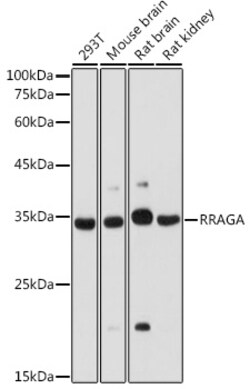
ABclonal Technology RRAGA Rabbit pAb

Enables several functions, including GTP binding activity, protein dimerization activity, and ubiquitin protein ligase binding activity. Involved in several processes, including cellular response to amino acid starvation, negative regulation of autophagy, and positive regulation of TORC1 signaling. Located in lysosome and nucleus. Colocalizes with GATOR1 complex.

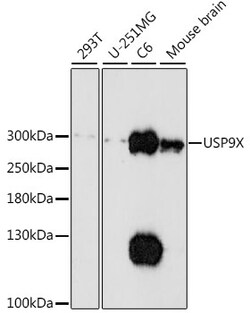
ABclonal Technology USP9X Rabbit pAb
This gene is a member of the peptidase C19 family and encodes a protein that is similar to ubiquitin-specific proteases. Though this gene is located on the X chromosome, it escapes X-inactivation. Mutations in this gene have been associated with Turner syndrome. Alternate transcriptional splice variants, encoding different isoforms, have been characterized.
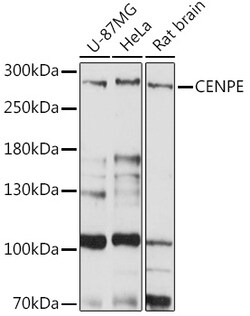
ABclonal Technology CENPE Rabbit pAb
Centrosome-associated protein E (CENPE) is a kinesin-like motor protein that accumulates in the G2 phase of the cell cycle. Unlike other centrosome-associated proteins, it is not present during interphase and first appears at the centromere region of chromosomes during prometaphase. This protein is required for stable spindle microtubule capture at kinetochores which is a necessary step in chromosome alignment during prometaphase. This protein also couples chromosome position to microtubule depolymerizing activity. Alternative splicing results in multiple transcript variants encoding distinct protein isoforms.
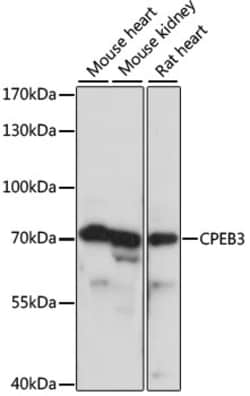
ABclonal Technology CPEB3 Rabbit pAb
Enables mRNA 3-UTR binding activity and translation factor activity, RNA binding. Involved in cellular response to amino acid stimulus, negative regulation of transcription by RNA polymerase II, and positive regulation of mRNA catabolic process. Located in several cellular components, including cytosol, midbody, and nucleoplasm. Part of CCR4-NOT complex.
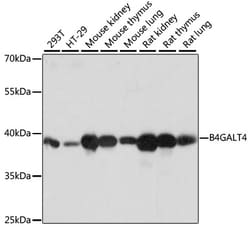
ABclonal Technology B4GALT4 Rabbit pAb
This gene is one of seven beta-1,4-galactosyltransferase (beta4GalT) genes. They encode type II membrane-bound glycoproteins that appear to have exclusive specificity for the donor substrate UDP-galactose, all transfer galactose in a beta1,4 linkage to similar acceptor sugars GlcNAc, Glc, and Xyl. Each beta4GalT has a distinct function in the biosynthesis of different glycoconjugates and saccharide structures. As type II membrane proteins, they have an N-terminal hydrophobic signal sequence that directs the protein to the Golgi apparatus and which then remains uncleaved to function as a transmembrane anchor. By sequence similarity, the beta4GalTs form four groups beta4GalT1 and beta4GalT2, beta4GalT3 and beta4GalT4, beta4GalT5 and beta4GalT6, and beta4GalT7. The enzyme encoded by this gene appears to mainly play a role in glycolipid biosynthesis. Two alternatively spliced transcript variants have been found for this gene.
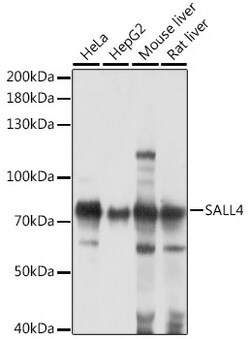
ABclonal Technology Sall4 Rabbit pAb
This gene encodes a zinc finger transcription factor thought to play a role in the development of abducens motor neurons. Defects in this gene are a cause of Duane-radial ray syndrome (DRRS). Alternative splicing results in multiple transcript variants encoding different isoforms.
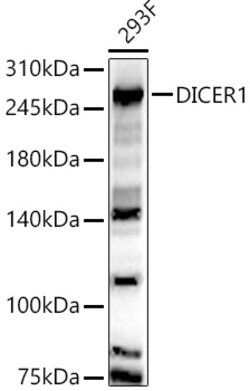
ABclonal Technology DICER1 Rabbit pAb
This gene encodes a protein possessing an RNA helicase motif containing a DEXH box in its amino terminus and an RNA motif in the carboxy terminus. The encoded protein functions as a ribonuclease and is required by the RNA interference and small temporal RNA (stRNA) pathways to produce the active small RNA component that represses gene expression. This protein also acts as a strong antiviral agent with activity against RNA viruses, including the Zika and SARS-CoV-2 viruses. Alternative splicing results in multiple transcript variants.
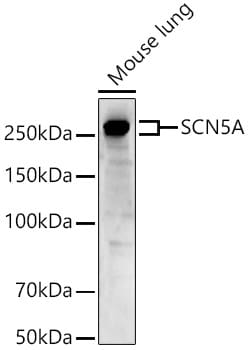
ABclonal Technology SCN5A Rabbit pAb
The protein encoded by this gene is an integral membrane protein and tetrodotoxin-resistant voltage-gated sodium channel subunit. This protein is found primarily in cardiac muscle and is responsible for the initial upstroke of the action potential in an electrocardiogram. Defects in this gene have been associated with long QT syndrome type 3 (LQT3), atrial fibrillation, cardiomyopathy, and Brugada syndrome 1, all autosomal dominant cardiac diseases. Alternative splicing results in several transcript variants encoding different isoforms.

Biotium Primary Antibody Rabbit IgG Fc N2507.RFC CF583R 1/EA
Alpaca Anti-Rabbit IgG (Fc) rVHH (N2507 RFC) is a recombinant Alpaca VHH antibody that recognizes the Fc fragment of rabbit IgG and is validated for immunofluorescence Red fluorescent STORM-compatible CF583R dye has Ex/Em at 583/606 nm Unit size 500 uL at 0 1 mg/mL
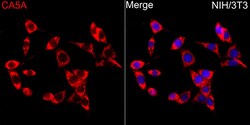
ABclonal Technology CA5A Rabbit pAb
Carbonic anhydrases (CAs) are a large family of zinc metalloenzymes that catalyze the reversible hydration of carbon dioxide. They participate in a variety of biological processes, including respiration, calcification, acid-base balance, bone resorption, and the formation of aqueous humor, cerebrospinal fluid, saliva, and gastric acid. They show extensive diversity in tissue distribution and in their subcellular localization. CA VA is localized in the mitochondria and expressed primarily in the liver. It may play an important role in ureagenesis and gluconeogenesis. CA5A gene maps to chromosome 16q24.3 and an unprocessed pseudogene has been assigned to 16p12-p11.2.
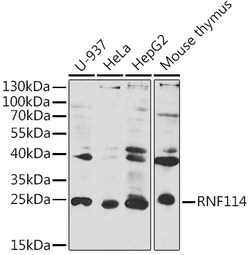
ABclonal Technology RNF114 Rabbit pAb
Predicted to enable ubiquitin protein ligase activity. Predicted to be involved in protein polyubiquitination and ubiquitin-dependent protein catabolic process. Located in cytosol and plasma membrane. Biomarker of male infertility.
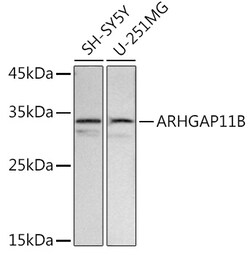
ABclonal Technology ARHGAP11B Rabbit pAb
Predicted to enable GTPase activator activity. Involved in cerebral cortex development and negative regulation of mitochondrial membrane permeability. Acts upstream of with a positive effect on glutamine catabolic process. Located in mitochondrial matrix.
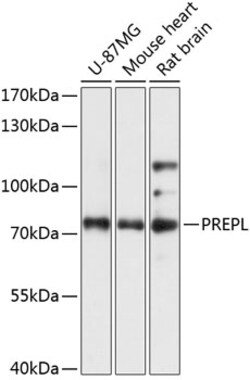
ABclonal Technology PREPL Rabbit pAb
The protein encoded by this gene belongs to the prolyl oligopeptidase subfamily of serine peptidases. Mutations in this gene have been associated with hypotonia-cystinuria syndrome, also known as the 2p21 deletion syndrome. Several alternatively spliced transcript variants encoding either the same or different isoforms have been described for this gene.

Enzo Life Sciences Prestained Protein Ladder (3.5 - 245 kDa) (500µl)
Enzo's Protein ladder is a three-color protein standard with 13 prestained proteins, covering a wide range molecular weights from 3.5 to 245 kDa. Proteins are covalently coupled with a blue chromophore except for two reference bands (one green and one red band at 25 kDa and 75 kDa respectively) when separated on SDS-PAGE (Tris-glycine buffer). Our Protein ladder is designed for monitoring protein separation during SDS-polyacrylamide gel electrophoresis, verification of Western transfer efficiency on membranes (PVDF, nylon, or nitrocellulose) and for approximating the size of proteins. The ladder is supplied in gel loading buffer and is ready to use. Do not heat, dilute or add reducing agent before loading. Formulation: Approximately 0.1~0.4 mg/ml of each protein in the buffer (20mM Tris-phosphate, pH 7.5 at 25°C), 2% SDS, 10mM Dithiothreitol, 3.6 M Urea, and 15% (v/v) Glycerol). Long Term Storage: -20°C. Applications: SDS-PAGE.

ABclonal Technology UBQLN4 Rabbit pAb
Enables K48-linked polyubiquitin modification-dependent protein binding activity and identical protein binding activity. Involved in cellular response to DNA damage stimulus, negative regulation of double-strand break repair via homologous recombination, and regulation of cellular catabolic process. Located in several cellular components, including autophagosome, nucleoplasm, and site of DNA damage. Part of protein-containing complex. Colocalizes with cytosolic proteasome complex and nuclear proteasome complex.